Traditional Filipino Games: Rediscovering the Childhood Street Games We Grew Up With
In today’s digital world, children are growing up surrounded by gadgets and technology. Smartphones, tablets, gaming consoles, and laptops have become part of their everyday lives, sometimes taking the place of face-to-face interactions and outdoor play with other children.
But before screens became a big part of childhood, kids spent hours playing outside with friends and neighborhood playmates. They ran under the sun, played barefoot on the streets, climbed trees, and turned everyday objects into toys. The games were simple, required little to no money, and relied mostly on creativity, imagination, and a whole lot of energy.
Growing up in the Philippines, some of my fondest childhood memories involved playing traditional Filipino street games with the neighborhood kids. We didn’t need expensive toys or sophisticated gadgets to have fun. All we needed was an open space, a few simple materials, a group of friends, and the imagination to turn an ordinary afternoon into an unforgettable adventure.
Today, these childhood games may feel like a #Throwback to a different generation, but they remain an important part of Filipino culture and heritage. Known collectively as Larong Pinoy, traditional Filipino games offer more than just entertainment. They encourage physical activity, teamwork, creativity, coordination, and meaningful social interaction.
As modern childhood becomes increasingly digital, it’s worth looking back at these timeless Filipino games and introducing them to the younger generation. Whether you grew up playing them in the streets of the Philippines or are discovering them for the first time, these games are a wonderful reminder that some of the best childhood memories don’t require a screen.
Here are some traditional Filipino games, mostly played outdoors and sometimes enjoyed during community celebrations and town fiestas, that deserve to be remembered and passed on to the next generation.
http://mattersmost.deviantart.com/
1. Luksong Tinik (Jumping Over Thorns)
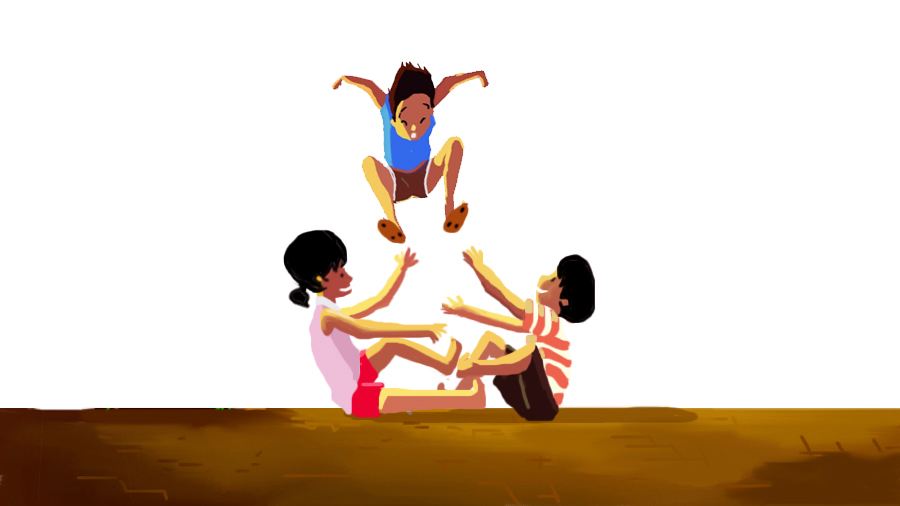
Luksong Tinik, which translates to “Jumping Over Thorns,” is a traditional Filipino outdoor game believed to have originated in Cabanatuan City, Nueva Ecija, Philippines.
The game is played by two teams with an equal number of players. Each team chooses a leader called the nanay (mother), while the remaining team members are referred to as anak (children). The nanay is usually the player who can jump the highest, as she may need to step in and help a teammate who fails to clear the obstacle.
The game requires no equipment. Instead, two players from the opposing team sit on the ground facing each other and use their feet and hands to form the tinik (thorn).
How to Play Luksong Tinik
-
Divide the players into two teams with an equal number of members. Each team selects a nanay, preferably the strongest jumper.
-
Two players from the opposing team sit facing each other, with the soles of their feet touching. These players form the initial tinik.
-
One by one, the opposing team’s players take turns jumping over the feet without touching them.
-
Once everyone has successfully jumped over the first obstacle, the seated players gradually add one foot or hand to increase the height of the tinik.
-
The players continue jumping as the obstacle gets higher with each round.
-
If a player fails to clear the obstacle, the team’s nanay gets a chance to make the jump on their behalf. If the nanay also fails, the teams switch roles.
The challenge is to jump over the growing thorn formation without touching it. It takes agility, balance, coordination, and a good jumping ability to make it through every round!
Beyond the physical challenge, Luksong Tinik is a game of teamwork and friendly competition. It’s one of those childhood games that kept everyone active, laughing, and cheering each other on.
Did You Know? Luksong Tinik is played using nothing but the players’ hands and feet. No toys, balls, or expensive equipment needed!
http://mattersmost.deviantart.com/
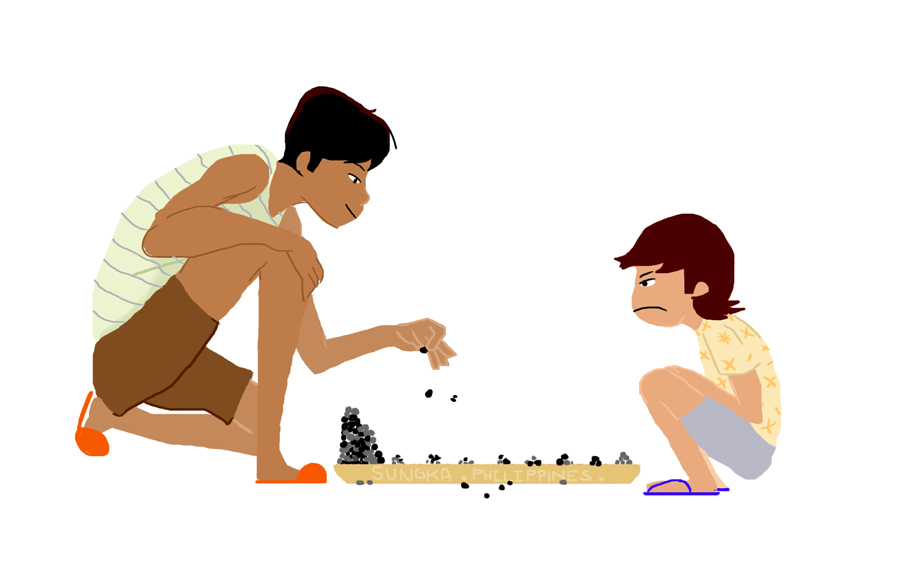
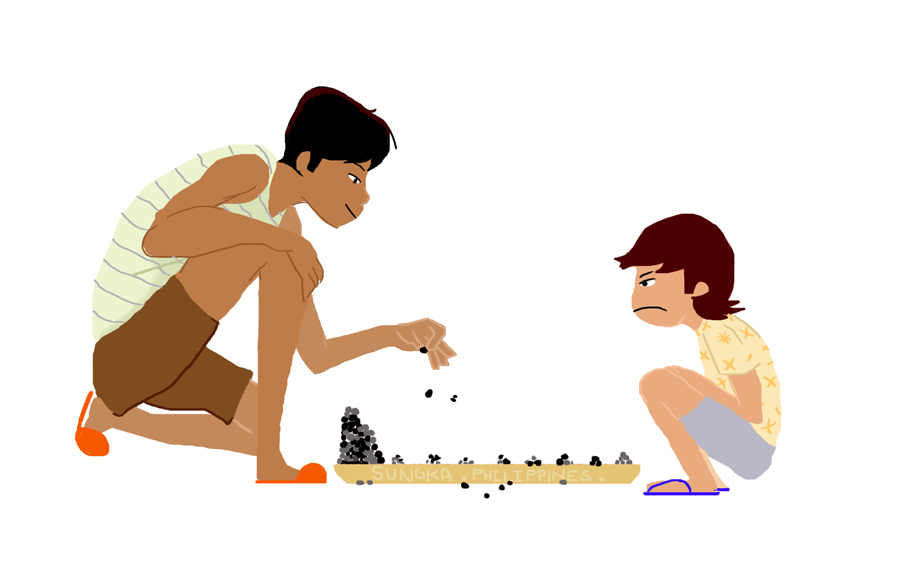
2. Sungka (Traditional Filipino Mancala Board Game)
Sungka is a traditional Filipino strategy board game that belongs to the mancala family of games. Often played by two people, it involves counting, distributing, and collecting small counters, usually seashells, using a specially designed wooden board.
The game is played on an oblong-shaped wooden board called a sungka(h)an, traditionally carved from hardwood such as mahogany. The board features two rows of seven small pits, known as bahay (houses), and two larger pits at either end called ulo (head) or inay (mother), which serve as collection stores.
Each player owns the store on their left side of the board. At the beginning of the game, each of the 14 small houses contains seven counters, traditionally cowrie shells known as sigay. The objective is to collect as many counters as possible in your store through strategic distribution around the board.
A Glimpse Into Sungka’s History
Sungka has a long history in the Philippines. One of its earliest documented references dates back to 1692, when Jesuit missionary Father José Sánchez described a similar game called Kunggit in his manuscript dictionary of the Bisaya (Cebuano) language.
According to historical accounts, the game was played using seashells on a wooden board shaped like a boat. The name Kunggit is still used by the Aklanon people today, reflecting the regional variations and cultural roots of this traditional Filipino pastime.
How to Play Sungka
-
Two players sit opposite each other, with each player controlling one row of seven small houses and their designated store.
-
Each of the 14 houses starts with seven shells or counters.
-
A player picks up all the shells from one of their houses and distributes them one at a time into the following houses, moving around the board according to the game’s direction of play.
-
Players continue distributing their shells strategically, aiming to collect as many counters as possible in their own store.
-
The game continues until the small houses on one side are empty. The player with the most shells collected in their store wins.
Sungka is more than just a traditional Filipino board game. It encourages strategic thinking, concentration, counting skills, and patience. Unlike many outdoor Larong Pinoy games, Sungka can be enjoyed indoors, making it a popular pastime for families and friends.
It’s a reminder that childhood entertainment doesn’t always have to involve running around or expensive gadgets. Sometimes, all you need is a wooden board, a handful of seashells, and a little strategy!

https://mattersmost.deviantart.com/
3. Kadang-Kadang & Sangkayaw (Traditional Filipino Stilt Games)
Before modern playgrounds and electronic games became popular, Filipino children found creative ways to turn ordinary materials into toys. Two examples are Kadang-Kadang and Sangkayaw, traditional Filipino outdoor racing games that test balance, coordination, and physical endurance.
Kadang-Kadang (Bamboo Stilt Race)
Also known as Tiyakad in Tagalog, Kadang-Kadang is a traditional Filipino racing game played using bamboo stilts. It is commonly featured during Larong Lahi (traditional Filipino games) competitions, community gatherings, and recreational activities.
Historical accounts trace the game to Cebu in 1969. The word kadang-kadang is also associated with a simple form of play, although its exact linguistic origin would benefit from further verification.
To play, each participant needs a pair of long bamboo poles fitted with small foot platforms or steps. Traditionally, the bamboo poles can measure approximately 10 feet from the ground, although shorter or taller versions may be used depending on the players’ abilities and the competition.
How to Play Kadang-Kadang
-
Each player gets a pair of bamboo stilts with foot platforms attached at equal heights.
-
Players position their feet on the platforms and hold the upper ends of the bamboo poles firmly with both hands.
-
Once the starting signal is given, participants begin walking or racing toward the designated finish line while balancing on the stilts.
-
The objective is to reach the finish line without falling or losing control of the bamboo stilts.
-
Depending on the competition rules, the first player to cross the finish line wins.
The game may look simple, but walking on bamboo stilts requires considerable balance, coordination, and concentration. It’s definitely not as easy as it looks!
Sangkayaw (Coconut Shell Race)
Another traditional Filipino racing game is Sangkayaw, also known as the Coconut Shell Race. Commonly associated with Central Luzon and Tagalog-speaking provinces, this game is similar to Kadang-Kadang because players must balance themselves while walking on improvised stilts.
The difference? Instead of bamboo poles, Sangkayaw uses coconut shells!
The game requires two coconut shell halves with holes drilled into them. Strings are attached to the shells, allowing players to hold the ends and control their movements while standing on the shells.
Sangkayaw is usually played in teams, with approximately 10 to 12 members per group.
How to Play Sangkayaw
-
Divide the participants into two teams, ideally with 10 to 12 players each.
-
Each player gets a pair of coconut shells with attached strings.
-
Players place their feet on the coconut shells and hold the strings firmly in their hands.
-
At the starting signal, the first player walks toward the designated goal line using the coconut shells.
-
After reaching the goal line, the player returns to the starting point and passes the turn to the next teammate.
-
The relay continues until every team member has completed the race.
-
The first team to finish the race wins. Players who fall and take more than two steps after falling may be disqualified, depending on the competition rules.
Unlike modern racing games, Sangkayaw turns something as ordinary as discarded coconut shells into a fun and challenging activity.
Both Kadang-Kadang and Sangkayaw remind us of the resourcefulness and creativity behind traditional Filipino childhood games. They prove that children don’t need expensive toys or sophisticated equipment to enjoy a little friendly competition!

https://mattersmost.deviantart.com/
4. Karera ng Gulong (Tire Rolling Race)
This game brings back so many childhood memories! Although Karera ng Gulong may not be considered one of the oldest traditional Filipino games, it perfectly represents the creativity and resourcefulness of Filipino children.
Who would have thought that an old, discarded car tire could provide hours of entertainment?
The game uses old tires, sometimes cut or modified to create a lighter, manageable rolling ring, along with a wooden stick used to push, guide, and keep the tire moving. Once the players have their tires ready, the race begins!
The objective is simple: roll the tire toward the finish line using the stick without letting it fall over. Players must keep their tires moving while maintaining control and balance, making quick adjustments whenever the tire starts to wobble or veer off course.
How to Play Karera ng Gulong
-
Each player needs an old tire or a suitable tire ring and a wooden stick.
-
Players line up at the starting point with their tires positioned upright.
-
Once the signal is given, everyone starts rolling their tires toward the finish line using their sticks.
-
Players must keep their tires upright and moving in the right direction without losing control.
-
The first player to reach the finish line with their tire still upright wins!
What makes this game special is its simplicity. No batteries, no complicated instructions, and no expensive toys. Just an old tire, a stick, an open street, and a group of kids ready to race!
Beyond the fun, Karera ng Gulong helps develop hand-eye coordination, balance, motor skills, and concentration. More importantly, it shows how Filipino children can turn everyday discarded materials into something entertaining and memorable.
Sometimes, the best childhood toys aren’t bought from a store. They’re created out of whatever you can find!
https://mattersmost.deviantart.com/
5. Nanay, Tatay (Filipino Hand-Clapping Game)
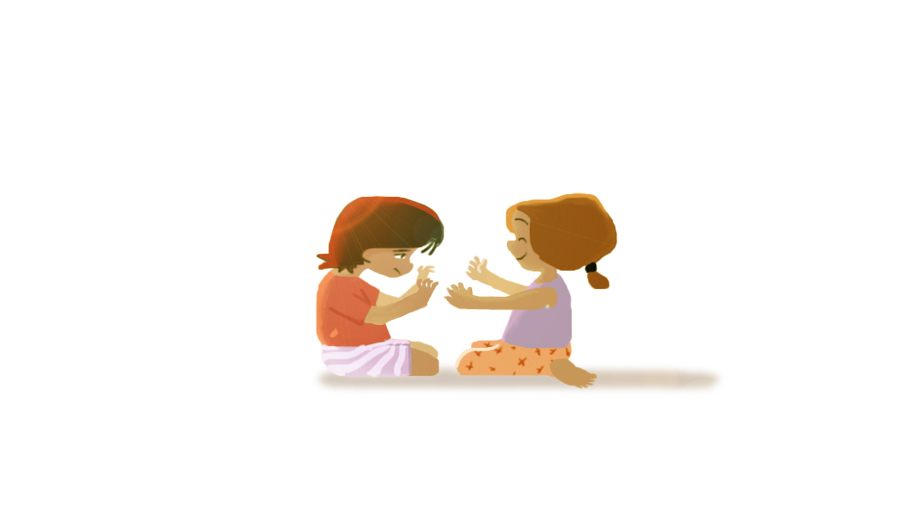
A testament to Filipino musicality and creativity, Nanay, Tatay is a popular childhood hand-clapping game accompanied by a catchy and rhythmic Filipino chant. It may seem like a simple playground activity, but it combines music, coordination, memory, and a little friendly competition.
The chant, which literally refers to asking Nanay (Mother) and Tatay (Father) for a piece of bread, also includes playful references to siblings and family relationships. In a humorous way, the lyrics reflect familiar family dynamics, making the game even more relatable to Filipino children.
Unlike outdoor racing games, Nanay, Tatay requires no equipment or special playing area. All you need is a partner, a good sense of rhythm, and a willingness to keep up with the increasingly faster pace!
How to Play Nanay, Tatay
- Find a partner and face each other.
- Begin the hand-clapping routine while singing the familiar Nanay, Tatay chant.
- Follow the rhythm by clapping your own hands and your partner’s hands in a repeating pattern.
- As the chant progresses, the players continue with the accompanying counting sequence, gradually increasing the speed.
- Keep up with the rhythm and count without missing a beat or making a mistake.
- The game continues until one player loses the rhythm, misses a clap, or gets the counting sequence wrong.
The player who makes a mistake loses the round. Depending on the players’ agreed-upon rules, the winner may give the loser a playful consequence, such as a gentle pinch on the ear.
What makes Nanay, Tatay memorable is how something as simple as a hand-clapping routine can turn into hours of laughter and friendly competition. It also helps children develop rhythm, concentration, coordination, and memory.
Sometimes, all it takes is a familiar Filipino tune, two pairs of hands, and a good friend to bring back the happiest childhood memories!
https://mattersmost.deviantart.com/
6. Palo Sebo (Greased Bamboo Pole Climbing)
If there’s one traditional Filipino fiesta game that combines strength, determination, and teamwork, it’s Palo Sebo!
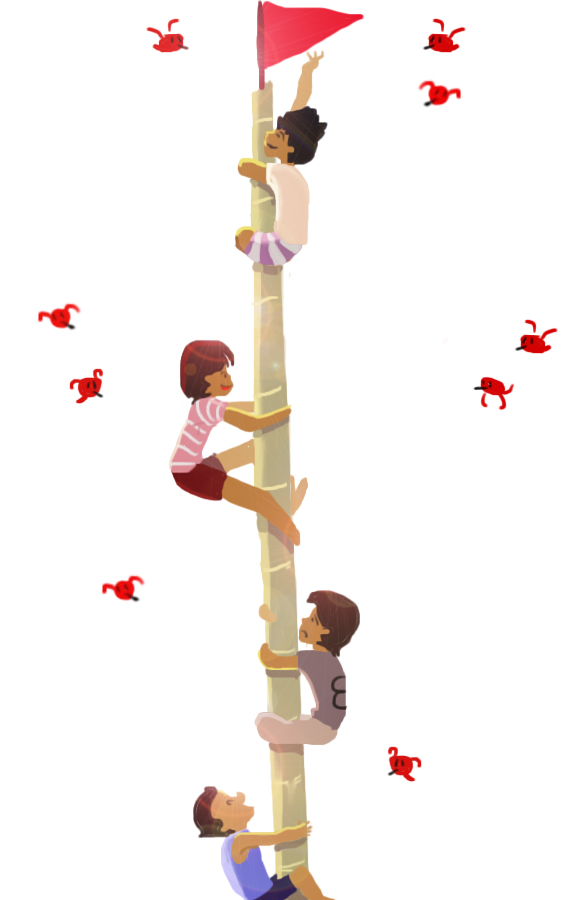
Palo Sebo is a traditional Filipino game commonly played during town fiestas and community celebrations. The challenge is simple but far from easy: climb a tall, slippery bamboo pole and grab the prize waiting at the top.
To prepare for the game, a long bamboo pole is polished and coated with grease or oil to make its surface extremely slippery. The pole is then positioned upright, and a small bag containing a prize is attached to its tip. The prize usually consists of money, toys, or other goodies.
How to Play Palo Sebo
- A long bamboo pole is securely positioned upright and coated with grease or oil to make climbing difficult.
- A prize bag containing money, toys, or other rewards is tied to the top of the pole.
- Contestants take turns attempting to climb the slippery bamboo pole and reach the prize.
- Players must use their strength, balance, and climbing skills to make their way to the top.
- The winner is the contestant who successfully reaches the top and unties the prize.
The Teamwork Challenge
To make the game even more exciting, Palo Sebo can also be played as a team competition. Two teams, each consisting of three to five or more players, work together to reach the prize.
Instead of climbing individually, teammates form a human ladder, allowing a designated player to step on their teammates’ shoulders to gain additional height and reach the prize. This variation encourages cooperation, communication, and teamwork.
The first team to successfully retrieve the prize wins the competition.
Palo Sebo is a perfect example of how Filipino fiestas turn simple activities into exciting community events. It takes more than physical strength to win; determination, strategy, and sometimes a little help from friends can make all the difference!
If you enjoyed reading these tidbits of information, hit the share button for your social channels to share the love. For other use, please mention due credit especially the digital illustrations used in this post. Make sure to subscribe to my mailing list to read my latest blog straight from your inbox. Or, follow me on Facebook or Instagram to know the latest snippet from me. For any questions, click on the “contact us” on top to email me or comment below.
Con mucho amor,
Imelda ❤️


I missed all these games…I will show my son if we ever come for vacations 🙂 thanks for putting all these, salamat! Mabuhay!